An Employee Has Been Injured at Work. What Happens Next?
When it comes to Workers’ Compensation Insurance, Tasmania has laws that require employers to have workers compensation insurance in place. But for many business owners, it’s something they may rarely think about beyond paying the premium — until an employee is actually injured at work.
That’s when the real purpose of workers compensation becomes much clearer.
Imagine Ben works for a small Hobart business.
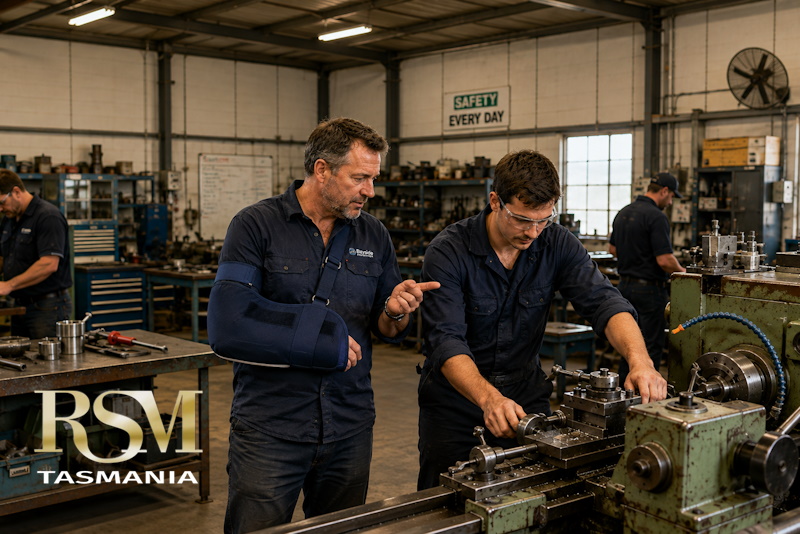
It was an ordinary working day when he slipped while moving some equipment, fell awkwardly and injured his shoulder. At first, everyone hoped it was nothing serious. A trip to the doctor, a few days of rest and he’d probably be back at work the following week.
Except he wasn’t.
The injury was more serious than anyone initially thought. And for Ben and his employer, what happened next would take considerably longer than the accident itself.
Ben is fictional, but his story represents the kind of situation Tasmanian businesses can find themselves dealing with after a workplace injury.
A Workplace Injury Doesn’t End at the Doctor’s Surgery
Ben was unable to perform his normal job, and his recovery involved medical appointments, treatment and rehabilitation.
Under Tasmania’s workers compensation system, an injured worker may be entitled to weekly compensation when totally or partially unable to work, along with reasonable and necessary medical, hospital, rehabilitation and other associated expenses.
For a significant injury involving five or more days of total or partial incapacity, an injury management coordinator is appointed to help coordinate treatment, rehabilitation and the return to work. Depending on the circumstances, doctors and workplace rehabilitation providers may also be involved.
Suddenly, Ben’s accident wasn’t simply an employee taking a few days off.
It had become an ongoing process.
Meanwhile, Someone Still Has to Do Ben’s Job
There’s another side to a workplace injury that can easily be overlooked.
Ben’s work didn’t disappear when Ben stopped being able to do it.
Initially, his employer shared the workload among the rest of the team. But as the weeks passed, that became increasingly difficult.
Other employees were working additional hours. Jobs were taking longer. Customers were still expecting the same level of service. Eventually, the business brought in someone temporarily to help cover Ben’s workload.
And those are real operational costs.
Workers compensation insurance can provide important protection for costs arising from the worker’s injury, but it doesn’t make every knock-on effect of losing a key employee disappear.
The business still has customers to look after, deadlines to meet and work that needs doing.
Getting Back to Work Can Be a Gradual Process
Fortunately, Ben began improving.
But returning to work didn’t necessarily mean going straight from being unable to work on Friday to performing his full job again on Monday.
Tasmania’s return-to-work system recognises that an injured employee may be able to perform suitable alternative duties while recovering. These need to take account of the worker’s capacity, skills and medical restrictions and can form part of the return-to-work arrangements.
So Ben came back gradually.
For his employer, that meant continuing to manage the workload while also supporting Ben’s recovery and making sure the work he was given was appropriate.
The employee was recovering.
The business was recovering too.
What If Your Workers Compensation Arrangements Aren’t Right?
Ben’s fictional story raises a very real question for employers considering their Workers Compensation arrangements.
If one of your employees was seriously injured tomorrow, how confident are you that your workers compensation insurance accurately reflects your business today?
Businesses change.
You employ more people. Your payroll increases. Employees take on different roles. The type of work you undertake may change as the business grows.
Insurance arrangements made when the business was smaller shouldn’t simply be forgotten in a filing cabinet while everything around them changes.
A significant workers compensation claim can involve income support, treatment and rehabilitation over an extended period. At the same time, the business itself may be dealing with additional staffing costs, lost productivity and disruption while the employee is away.
That’s not the time you want to discover there’s a problem with your insurance arrangements.
Protecting Your Employee — And Your Business
Workers compensation isn’t simply another piece of paperwork businesses have because the law requires it.
When someone is genuinely injured, it helps provide the framework and financial support that allows them to receive treatment, recover and, where possible, return safely to work.
And while Ben’s accident couldn’t have been undone by an insurance policy, having the right arrangements in place can make an enormous difference to what happens afterwards.
If your business has grown, your payroll has changed or you’re simply unsure whether your current Workers’ Compensation Insurance Tasmania arrangements still reflect your business today, RSM Tasmania Insurance Brokers will help you review where you stand.
For more information about workers compensation, injury management and return-to-work requirements in Tasmania, visit WorkSafe Tasmania.
Remember, this article is general in nature and doesn’t account for your specific objectives, financial situation, or needs. For advice tailored to your circumstances, have a chat with us at RSM Tasmania Insurance Brokers Hobart.
Talk to Roger Hosie and stay ahead with RSM Tasmania’s insights.
Call Now! (03) 6244 7854, or email .
You can also follow RSM Tasmania on Facebook and LinkedIn for regular business insights.
Click Here for more information specifically about workers compensation in Tasmania,
visit: https://wcomptas.com.au/